No items found.


Contact us
Thank you! Your submission has been received!
Oops! Something went wrong while submitting the form.

Flour’s Hidden Cost: The Margin You Never Saw

October 19, 2026
October 21, 2026
Oct 19, 2026
Somewhere in a large bakery right now, margin is leaking, and no one can point to where. It does not show up as a line item, and it is not the result of any mistake. It is simply the cost of the largest ingredient input, flour, behaving in ways no one could see coming. For as long as bakeries have existed, that cost has been absorbed as the price of doing business. The difference today is that it no longer has to be.
An industry that already agrees on the problem
This is not one company’s theory. Dale Easdon, chief executive of Klosterman Baking Co., puts it simply: any variation in a major ingredient like wheat forces his team to make adjustments to hold quality. Richard Charpentier, a Certified Master Baker who addressed this year’s BakingTech, reminds bakers that flour is the single most expensive ingredient they buy, and that it varies with how it is grown, harvested, milled and stored. Puratos opened a dedicated center in 2026 to better understand flour, with chief R&D officer Paul Baisier calling it one of the most complex and variable raw materials in the industry. Millers, analysts and ingredient companies across the U.S. and Europe are converging on the same conclusion.
A number big enough to matter
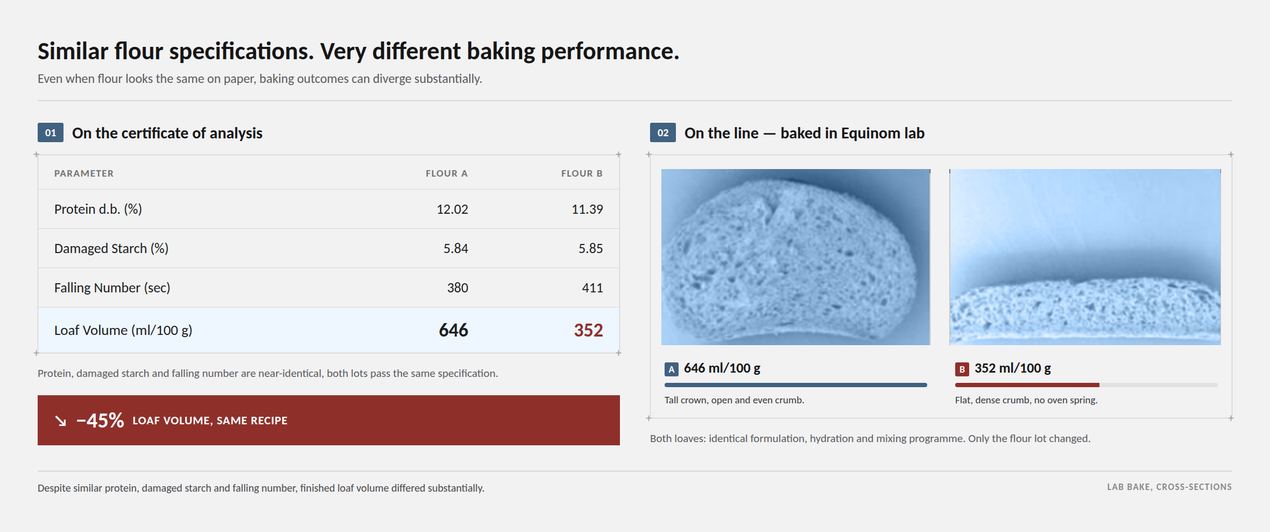
The scale is easy to underestimate. Commercial baking is roughly a $79 billion market in the U.S. and approaches $500 billion worldwide, and flour is the largest single ingredient cost across it. Yet the specification bakeries buy on barely predicts how that flour will actually run. In a 2024 analysis of the U.S. hard red winter crop, Dr. Jeff Gwirtz of Kansas State University found that protein content explained less than half of the variation in water absorption, and only about two-thirds of the variation in finished loaf volume. Two lots that meet the same protein spec can behave very differently on the line, and the Certificate of Analysis may not warn you.
Source: ©Equinom
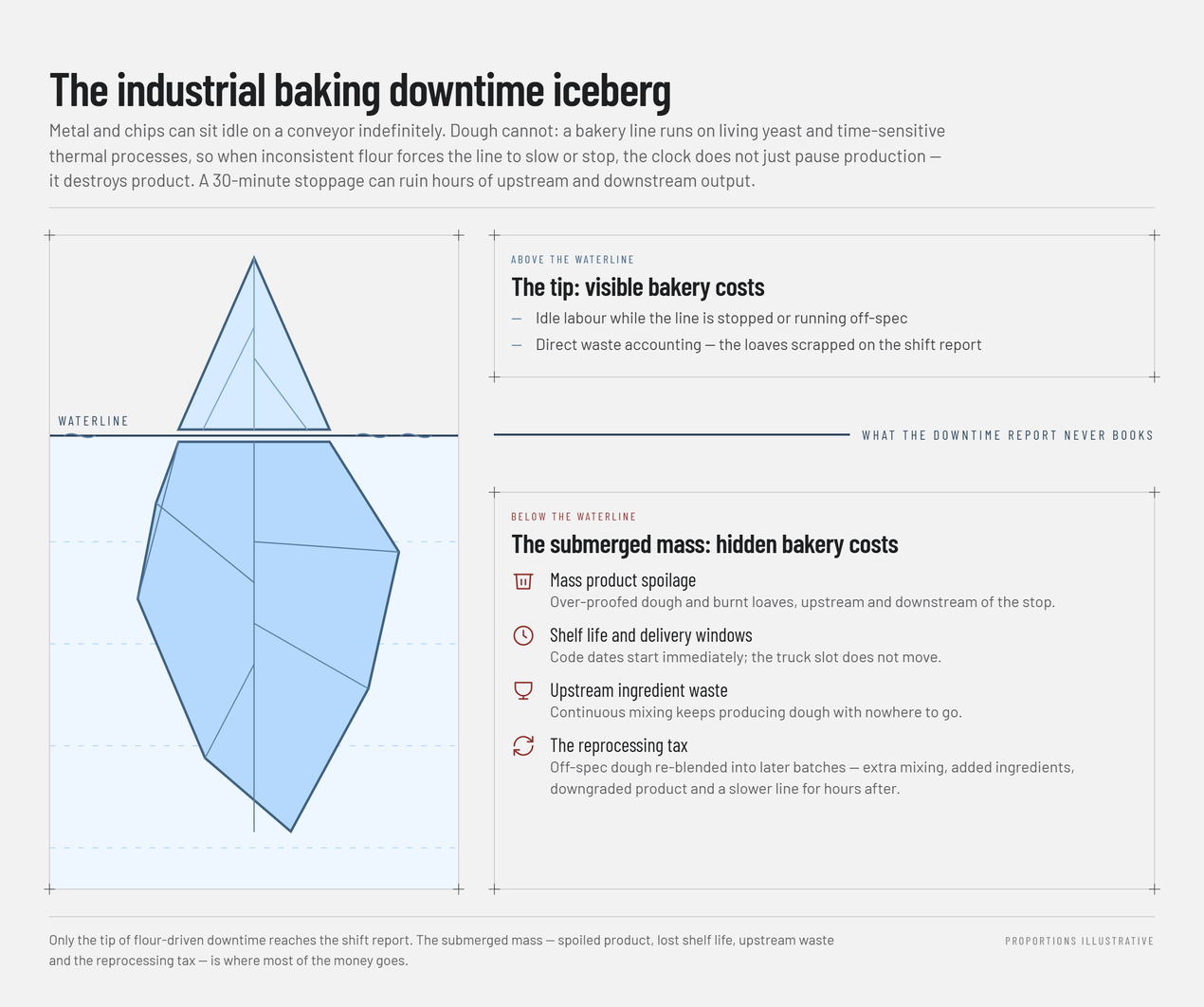
The cost of that gap is real. Published estimates put unplanned downtime in food manufacturing at $50,000 to $300,000 an hour depending on the line and facility, and ABB’s cross-industry research pegs the average near $125,000 an hour. Flour is not the only cause of a line stopping, but it is a meaningful one. Equinom estimates that flour-attributable downtime alone costs a bakery between $100,000 and $250,000 per production line every year, a figure rarely isolated before, drawn from Equinom’s analysis across pilot engagements that separates flour-driven loss from other causes. The loss stayed invisible precisely because it was unmeasurable. That, more than any statistic, is the opportunity.
Source: ©Equinom
Connecting the raw material to the line
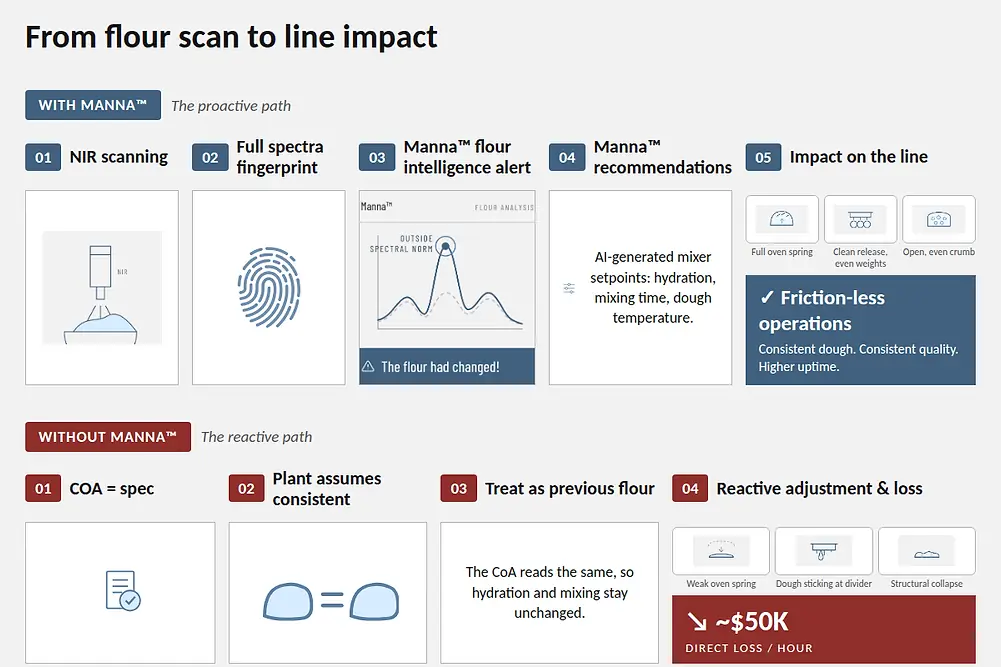
This is the gap Equinom set out to close. The industry has long measured flour, and separately measured the line, but rarely connected the two. Manna™ for Bakers, developed by Equinom, reads the full near-infrared (NIR) spectrum of an incoming lot. NIR itself is not new; what is new is the intelligence layered on top of it, AI and machine-learning models that turn a raw spectrum into a clear prediction of how a flour will behave. Those models are developed and validated using a bakery’s own production data, connecting spectral differences to real line behavior. Once trained, routine screening at intake needs none of that: the read reaches the team in seconds, with no capital investment. Manna works with a bakery’s existing NIR equipment, and for bakeries without one, Equinom provides the device as part of the service at no additional cost. Instead of discovering a difficult lot in the mixer, a team sees it at the receiving dock, with time to make a small, confident adjustment before the dough is ever made.
One bakery chose to lead
Confronting a hidden, decades-old problem takes conviction. A leading U.S. commercial bakery, recognized for its scale and its leadership in operations and technology, took it on, collaborating with Equinom on a rigorous, evidence-first pilot that put the approach to a genuine test against real outcomes in a working bakery. We were candid throughout about what the technology does well and where it has limits. Distinguishing what the flour truly drives from everything else that varies on a line is difficult work, and doing it honestly is what makes a result credible.
What a pilot typically finds
Across pilot engagements, a consistent pattern shows up. A meaningful minority of incoming flour lots, often one in six to one in four, are flagged by Manna as biochemically distinct from the rest, even when their Certificates of Analysis look the same. Those flagged lots are disproportionately represented among the scrap, rework and downtime a plant later traces back to flour. The figures vary by bakery; the pattern does not.
A shift already underway
This is not an isolated deployment. Equinom is now working with leading bakeries and millers across North America and Europe, turning flour from a daily unknown into a measured, manageable input, without changing recipes, equipment or suppliers. The cost of flour inconsistency is already in the P&L of every bakery that has not yet measured it. What has changed is that it can now be measured, and the bakeries that move first can begin reducing a cost their competitors still cannot see.
Discover how Manna™ for Bakers can transform your operations.
Contact Roie Davidovich, VP Business Development: roied@equi-nom.com, or visit www.equi-nom.com.

Equinom Ltd.
Givat Brenner,
6094800, Israel
Equinom Inc.
Indianapolis, IN
46236, USA
Equinom Ltd.
Givat Brenner,
6094800, Israel
Equinom Inc.
Indianapolis, IN
46236, USA