No items found.



Contact us
Thank you! Your submission has been received!
Oops! Something went wrong while submitting the form.

WorldGrain.com
Nature or nurture? What really shapes wheat quality

August 25, 2025
May 31, 2026
By Itay Zemach, PhD, Plant Sciences and Genetics, Equinom Ltd.
and Lilach Aviad, VP Product & Marketing, Equinom Ltd.
Introduction: It’s Not Just in the Genes
If wheat quality were determined purely by genetics, flour performance would be easy to predict. One variety would behave the same way no matter where it was grown. But that’s not what millers or bakers experience. Two batches of the same wheat variety, planted in different regions, grown under different conditions, can produce flour with very different properties. One forms a strong, elastic dough, while the other struggles to hold structure.
This isn’t just a fluke. It’s a consistent and well-documented reality. And it points to a deeper truth: while genetics lays the foundation and can be controlled/shaped by multiyear breeding programs, it’s the unpredictable environment that delivers the final verdict.
Genetics Set the Potential—But the Field Decides the Outcome
Hard Red Winter (HRW) and Hard Red Spring (HRS) wheat are the workhorses of the U.S. baking industry. These two types are bred for improved protein strength, higher yield, and stability. But still, the same variety, planted in Kansas versus Colorado, or North Dakota versus Montana, can yield grains with different milling properties and different flour functionality.
While this divergence could stem from agronomic practices, their influence is often minor in predominantly rainfed systems. Our focus here is on the environmental factors that shape how genetic potential is expressed. It’s the classic nature vs. nurture dilemma, played out in every wheat field.
Real-World Evidence: The Same Variety, Different Results
Let’s take SY Rockford, a widely grown HRS variety, as an example. Regional trials show that when grown in North Dakota, it consistently produces wheat with higher protein content and better loaf volume compared to when it’s grown in neighboring Montana. Same genetics. Different outcome. Why?
The answer lies in the environment.
Climate: North Dakota tends to have a cooler, more stable grain-filling period, allowing for stronger protein development. Montana’s warmer, more variable conditions can stress the plant and limit functional trait expression.
Soil and Water: Subtle differences in soil composition and water availability can affect nutrient uptake and starch accumulation.
Agronomic Practices: Even within best practices, decisions around fertilization timing or harvest readiness interact with weather to influence final quality.
This pattern isn’t limited to SY Rockford. It shows up in other varieties such as ‘Faller’, ‘SY Ingmar’, ‘Linkert’, and in HRW cultivars grown across the Southern Plains as well.
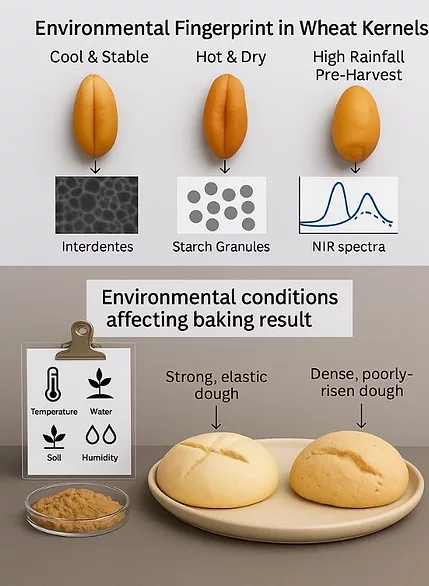
Credit: ©EQUINOM
Environmental Conditions that Influence Wheat Quality
Several environmental stressors have been shown to significantly affect grain quality:
High Temperatures During Grain Fill - Accelerates kernel maturation, leading to reduced test weight and weaker gluten formation due to altered protein composition.
Nitrogen Availability - Low nitrogen leads to lower protein levels and poor baking performance. Excess nitrogen might increase protein percentage without improving dough strength, as protein quality matters just as much as quantity. There is a growing tendency among environmental groups and state regulations to reduce nitrogen fertilization in fields.
Drought Stress – Limited water during key development stages impacts starch synthesis and the gliadin-to-glutenin ratio—key factors in dough behavior.
Late Rain & Sprouting Risk - Rain close to harvest increases enzymatic activity (notably alpha-amylase), lowers falling number, and can degrade loaf volume, even in sprouting-resistant varieties.
Humidity and Harvest Moisture - Moisture levels at maturity influence kernel hardness and flour granulation. This affects everything from milling energy to starch damage and water absorption.
AI as a Bridge Between Nature and Nurture
Given how influential growing conditions are, how can the industry respond?
This is where artificial intelligence (AI) plays a critical role. By learning from past patterns and integrating large-scale data from the field, AI models can forecast how wheat will perform, long before it reaches the mill.
How AI Helps:
Predict functional traits such as protein strength, water absorption, or falling number using NIR spectra, environmental history, and regional trends.
Flag variability before flour hits the mixer, giving bakers and millers time to adapt blends or adjust formulations.
Cluster wheat lots not just by protein level, but by expected dough behavior, based on environmental signatures.
Enable smarter sourcing and binning strategies that reduce rework, waste, and customer complaints.
Instead of relying solely on post-harvest lab tests, processors can now anticipate performance based on both genetics and the "nurture" side of the equation, weather, soil, and growing conditions.
Conclusion: Managing Variability Starts with Understanding It
The takeaway is clear: wheat quality is not just about what’s in the seed, but what happens in the field. Understanding the environmental side of the equation is essential to ensuring consistent flour performance.
AI doesn't change the fact that nature is variable, but it gives the industry tools to predict, adapt, and manage that variability with more confidence. In a world where climate patterns are becoming less predictable, the ability to forecast flour behavior and respond in real time isn’t a luxury, it’s a necessity.
For bakers, millers, and traders alike, the future of consistent flour quality lies at the intersection of nature, nurture, and data.

Equinom Ltd.
Givat Brenner,
6094800, Israel
Equinom Inc.
Indianapolis, IN
46236, USA
Equinom Ltd.
Givat Brenner,
6094800, Israel
Equinom Inc.
Indianapolis, IN
46236, USA